Gamma Squeeze Explained

How rapid call buying forces market makers into a self-reinforcing buying loop — and how to spot the buildup before price explodes

Monitor GEX for Squeeze Setups →
What is a Gamma Squeeze?

A gamma squeeze occurs when a surge in call option buying forces market makers to buy the underlying at an accelerating pace — creating a self-reinforcing price spiral. Unlike a short squeeze (which requires short sellers to cover), a gamma squeeze is driven entirely by the mechanics of options dealer hedging.

The key ingredient is out-of-the-money (OTM) call options. When traders aggressively buy OTM calls, dealers (who sell those calls) must buy the underlying to hedge. As price rises from that buying, previously OTM calls move closer to the money — their delta increases — requiring even more buying from dealers. The cycle continues.

The core feedback loop:
Traders buy OTM calls → Dealers buy underlying to hedge → Price rises → OTM calls become ATM (delta surges) → Dealers must buy more underlying → Price rises further → Repeat
Why Gamma Squeezes Happen So Fast

The speed of a gamma squeeze comes from the non-linear nature of gamma:

  • Delta accelerates non-linearly: An OTM call at 0.10 delta doesn't just linearly climb to 0.50 — gamma makes the rate of change itself accelerate near the strike
  • Near expiry = maximum gamma: Short-dated OTM calls have the highest gamma per dollar. Weekly and 0DTE options are most prone to squeeze dynamics
  • Dealer size matters: When market makers collectively hold millions of options contracts, even small delta changes require enormous underlying purchases
  • Thin liquidity amplifies it: In low-volume stocks or at market open/close, dealer buying moves price further per dollar spent
  • Reflexivity: Rising price attracts more call buyers, adding fuel to the squeeze in real-time
The Four Stages of a Gamma Squeeze
Stage 1: Initial Call Accumulation

What's happening: Traders begin buying OTM call options — often cheap, short-dated, slightly above current price.

GEX signal: Modest buildup in call gamma at OTM strikes. GEX profile shows increasing green bars above current price. Volume in near-expiry calls starts rising relative to recent average.

Price action: Price is stable or grinding higher slowly. Most traders see nothing unusual.

Stage 2: Dealer Hedging Kicks In

What's happening: Dealers must buy the underlying to delta-hedge the calls they've sold. This buying pressure begins to lift price.

GEX signal: GEX levels at OTM strikes are now significant. The GEX profile shows the next call wall has moved up with the accumulated OI. Total gamma is rising rapidly.

Price action: A steady, low-volume grind up begins. Price approaches the concentration of OTM strikes. Volume starts to pick up as price moves toward the next call wall.

Stage 3: Acceleration — OTM Becomes ATM

What's happening: Calls that were OTM are now near the money. Their delta surges from ~0.15 to ~0.45-0.50. Dealers must aggressively buy more underlying. This is the "squeeze" moment.

GEX signal: The call wall is now at or near current price. Gamma exposure at that strike is at its highest. New call buying at higher strikes begins — extending the squeeze.

Price action: Rapid, high-volume price surge. Breakout from prior range. Often looks like a "vertical" move. Shorts begin panicking (combining gamma and short squeeze dynamics).

Stage 4: Exhaustion or Extension

What's happening: One of two outcomes: (A) call buying stops, gamma starts to decay, price consolidates or reverses. (B) Fresh call buying at new strikes extends the squeeze further.

GEX signal: Watch whether new OTM call OI is being established at higher strikes. If yes — extension likely. If GEX at OTM strikes is declining — exhaustion incoming.

Price action: Either sharp reversal (when dealer buying stops and early call buyers take profit), or continued grind higher with decreasing momentum as gamma exhausts.

Gamma Squeeze vs Short Squeeze: Key Differences
Gamma Squeeze Short Squeeze
Driven by options dealer hedging mechanics Driven by short sellers forced to cover
Requires large OTM call open interest Requires high short interest ratio
Can happen in low-short-interest stocks Requires significant existing short base
Speed: can start within hours Speed: usually develops over days
Visible in GEX data before it starts Visible in short interest data
Ends when call buying stops Ends when short covering exhausts
Most powerful near expiration Most powerful when float is low
Most explosive scenario: Both happening simultaneously — high short interest + aggressive call buying + near-expiry options. The gamma squeeze forces price up, which triggers short covering, which amplifies the move further.
How GEX Data Signals a Potential Squeeze

These GEX signals suggest gamma squeeze conditions are building:

  • Rapidly growing OTM call gamma: A strike 2-5% above current price suddenly accumulates large open interest in short-dated calls
  • Rising call/total GEX ratio: Call gamma growing faster than put gamma shifts the balance toward dealer buying pressure
  • GEX call wall above current price: A large call wall just above price means dealers are already buying as price approaches it
  • Acceleration in near-expiry OI: This week's or today's options accumulating gamma faster than longer-dated options — near-expiry gamma is more powerful
  • Flat or positive gamma terrain above: Little negative gamma resistance above the call wall means price can move freely once the squeeze starts
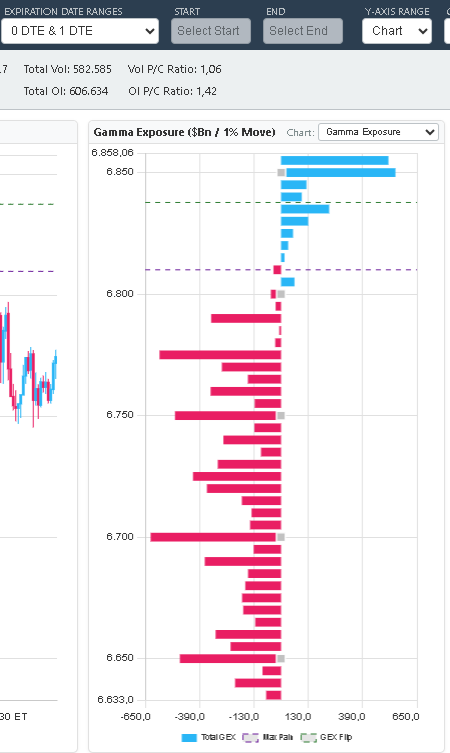
GEX Metrix 0DTE gamma exposure showing large Call Wall buildup at upper strikes — classic gamma squeeze setup

GEX Metrix — 0 DTE & 1 DTE Gamma Exposure. Notice the dominant blue Call Wall at the ~6,850 strike (top of chart). This large call concentration forces dealers to buy aggressively as price approaches — the exact mechanics that ignite a gamma squeeze. When traders pile into these OTM calls, the squeeze self-reinforces. Total Vol: 582,585 — OI P/C Ratio: 1.42.

Gamma Squeezes in Index Futures (ES, NQ)

Gamma squeezes aren't only a single-stock phenomenon. Index-level squeezes in SPX/NDX directly drive ES/NQ futures:

Index gamma squeeze conditions

When SPX call buying surges across multiple strikes, the combined dealer hedging requirement can drive ES futures sharply higher — often on seemingly "no news" days. The catalyst is the options market, not fundamental news. Traders watching only price action or fundamental catalysts miss the actual driver.

ES/NQ squeeze signal: Check SPX GEX. When call gamma above current price suddenly doubles or triples within a session, prepare for potential squeeze-driven acceleration in ES/NQ.
Index gamma squeezes are typically shorter-lived than single-stock squeezes. The deep liquidity of the index means dealers can source hedging shares more easily, reducing the reflexive amplification. Use tighter targets and faster exits than you would for a single-stock squeeze.
Risk Management Around Gamma Squeezes

Gamma squeezes are high-reward but high-risk. Managing that risk is essential:

  • Never chase a vertical move: The best entry is early-stage (Stage 1-2), not when the squeeze is obvious. Late entry means maximum risk and minimum remaining upside.
  • Watch for exhaustion signals: Declining volume on continued price rise is a squeeze exhaustion warning. When call buying stops, the reversal can be as violent as the move up.
  • GEX profile decay = exit signal: If the GEX call wall you identified starts to shrink (options expiring or being closed), dealer buying will slow — often the first signal the squeeze is ending.
  • Know expiration date: Gamma squeezes in weekly options peak Thursday afternoon and exhaust at Friday's open. Position accordingly — don't hold through expiration when gamma collapses to zero.
  • Position size for volatility: Squeeze-driven moves have wide intraday ranges. Size down to account for the potential reversal magnitude.