Delta Exposure: Dealer Positioning & Directional Bias

Understand the directional pressure that market makers carry — and how it creates a persistent tilt in futures and equity markets that most traders never see

See Live Delta Exposure →
What is Delta Exposure?

Delta measures how much an option's value changes for a $1 move in the underlying. A call option has a delta between 0 and +1. A put option has a delta between -1 and 0. Delta Exposure (DEX) aggregates the total delta across all options positions that market makers hold.

Unlike gamma (which is symmetric and about speed of hedging), delta tells us the directional bias of dealer positioning. A large negative total delta means dealers are net short the market — they're holding more put exposure than call exposure, and the underlying itself is their hedge on the long side.

Simple analogy: If dealers are short $5 billion in delta (net short the market), they hold $5 billion worth of the underlying as a hedge. Any price move that changes that delta requires them to adjust that hedge — creating directional flows that move price.
  • Call delta: 0 to +1 (dealers short calls = dealers long underlying to hedge)
  • Put delta: -1 to 0 (dealers short puts = dealers short underlying to hedge)
  • Total dealer delta is often negative in put-heavy markets
  • Delta exposure reveals the structural directional tilt of the market
Dealer Delta vs Market Direction

Dealer delta exposure creates a structural background force on price. Here's how to interpret it:

🟢 Net Positive Dealer Delta

Dealers are net long the underlying (more call exposure than put exposure). To rebalance, dealers may need to sell if price rises too much. Creates mild overhead pressure. Common in strong uptrend conditions with elevated call buying.

🔴 Net Negative Dealer Delta (Most Common)

Dealers are net short the underlying (more put exposure than call exposure). They hold the underlying as a hedge. As puts decay or get closed, dealers sell their underlying hedge, creating selling pressure. This is structural selling — not panic, not news-driven, just mechanical unwinding.

Why is dealer delta usually negative? Institutions and retail traders buy puts for portfolio protection far more often than they buy calls. Dealers take the other side — selling puts and hedging with short underlying positions.
The Zero Delta Level: A Second Structural Reference

The Zero Delta Level is the price at which total dealer delta exposure is zero — they're neither net long nor net short the underlying. It functions similarly to the Zero Gamma level but operates on a slower timescale.

  • Above Zero Delta: Dealers hold net long underlying — potential overhead selling as price rises
  • Below Zero Delta: Dealers hold net short underlying — structural buying support below current price
  • At Zero Delta: Minimal directional hedging flow — price can move more freely
Delta vs Gamma levels: Zero Gamma is more important for intraday volatility regime. Zero Delta is more useful for multi-day or swing trade directional bias. Use both together for the complete picture.
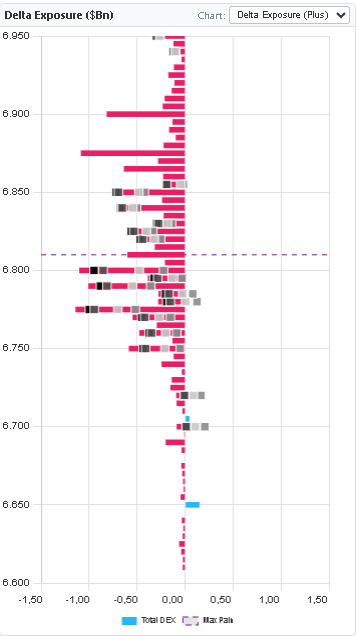
GEX Metrix Delta Exposure chart for SPX showing dealer delta positioning by strike with Max Pain level

Delta Exposure ($Bn) — GEX Metrix Plus tier. Shows dealer delta positioning by strike. Blue dashed = Max Pain. The mixed positive/negative bars reflect complex dealer hedging across the strike range. This is the directional tilt built into current dealer positioning.

Delta Exposure vs Gamma Exposure: What Each Tells You

Delta and Gamma are related but provide different types of information:

🎯 Gamma Exposure tells you...

  • Speed of hedging at each level
  • Whether today is range or trend
  • Where support/resistance is strongest
  • Intraday volatility regime
  • Short-term price magnetism

🎯 Delta Exposure tells you...

  • Directional bias of current positioning
  • Structural buying/selling overhang
  • Multi-day trend pressure
  • Where dealer rebalancing creates flows
  • Put/call positioning skew
Combined insight example: Positive gamma (stabilizing) + large negative dealer delta = dealers are hedging a big short position. Range-bound day expected, but structural selling overhang may limit upside across multiple sessions.
How Futures Traders Use Delta Exposure

Practical applications for ES/NQ traders:

  • Swing trade directional filter: In a deeply negative delta environment, upside momentum often fades as dealers unwind long hedges. Prefer shorts or tighter long targets.
  • Rally confirmation: A rally that moves price through the Zero Delta level often triggers dealer covering (buying) that amplifies the move — watch for acceleration.
  • OpEx week delta unwind: As expiration approaches, delta decays rapidly. Dealers unwind large hedge positions, creating directional flows — often bullish in put-heavy environments.
  • Pairs trading context: Comparing delta exposure between SPX and NDX can reveal which index has more structural headwind/tailwind for a relative value trade.
Delta exposure is most reliable as a filter, not a trigger. Use it to assess whether the structural environment supports your directional bias, not as a standalone entry signal.
The Delta Profile: Simulated Dealer Flows Across Price Range

The Delta Profile shows how total dealer delta exposure would change at each price level — simulating what happens to dealer hedging flows as price moves through different strikes.

  • A steep negative slope = strong structural selling zone as price rises
  • A flat section = low delta flow pressure (price can move freely)
  • A positive slope = structural buying support below current price
  • Crossings of the zero line = directional inflection points
GEX Metrix Delta Exposure chart for SPX — dealer delta by strike showing directional positioning skew

Delta Exposure detail — the concentration of bars near current price (~6,775–6,850) shows where dealer delta rebalancing will be most active. Strikes with large delta overhang create structural buying or selling flows as positions are unwound or rolled. Available in GEX Metrix Plus.

Delta Exposure During Market Stress

Delta dynamics change significantly during market stress events:

During a sharp selloff

Put buying surges. Dealers take the other side — becoming more short puts and more long underlying as hedges. As put open interest grows, dealer delta becomes increasingly positive (long underlying). This builds a structural support floor below current price — the market's "elastic band" that eventually pulls it back up.

During a grind-up rally

Call buying increases, put protection is abandoned. Dealers accumulate net long positions to hedge calls sold. Dealer delta tilts positive. As calls decay, dealers must unwind longs — creating subtle selling pressure that caps rallies even when news is positive.

Key takeaway: Extreme delta readings often precede mean reversion. A historically large negative dealer delta often signals too much put protection was bought — a contrarian bullish signal over multi-week timeframes.